Guide · AI Governance & Data Governance AI Governance vs. Data Governance: What’s the Difference?
By Mary Hartwell, Founder, Hartwell & Co.
The short answer
AI governance determines how AI should be used responsibly. Data governance ensures the information AI consumes is accurate, trusted, secure, and fit for purpose. They aren’t competing priorities, they’re symbiotic: without data governance, there is no responsible AI.
Somewhere along the way, AI governance became the headline and data governance got pushed to the background. That can become very dangerous. AI governance is not replacing data governance. It never will.
Side by side
| Data governance | AI governance | |
|---|---|---|
| Its job | Ensures the information AI consumes is accurate, trusted, secure, and fit for purpose | Determines how AI should be used responsibly |
| The question | Do you trust the data feeding your AI? | Can you establish AI governance and accountability? |
| What it covers | Ownership, stewardship, decision rights, data quality, metadata, master data management (MDM) | Ownership, an AI inventory, risk tiers, controls, oversight, AI policy |
| What it creates | Trusted data your organization relies on for decision making | Accountability for how AI is used |
Why AI governance can’t replace data governance
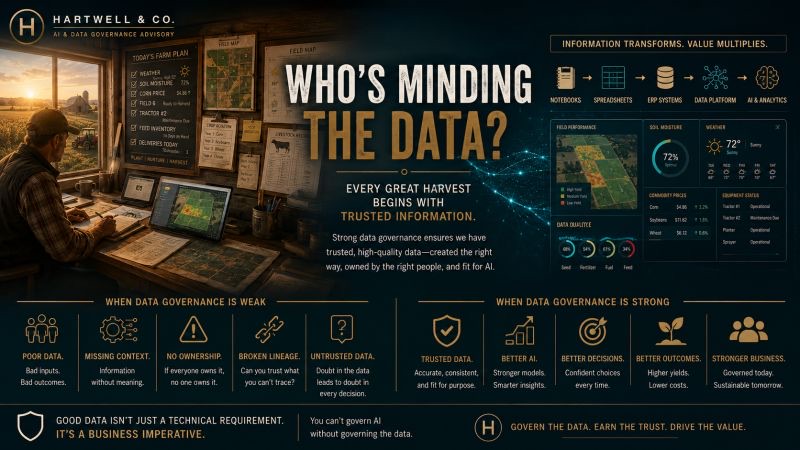
AI governance cannot compensate for an ungoverned data foundation.
Bad data doesn’t become good data because you fed it to AI. Clean data is the foundation to any successful AI program, and data governance is what keeps it clean. As organizations rush to establish AI governance programs, that foundation is the part getting lost.
Where organizations go wrong
- Treating data quality as a project. Organizations put all the effort into making sure the data is clean once, and then forget about it. Data integrity and high data quality are ongoing necessities, not one-time projects.
- Assuming approved means governed. “Sanctioned” AI, even if procurement approved it, may still lack proper governance.
- Not knowing where AI is being used. You cannot secure what you cannot see. Visibility is the first step to governance.
- Skipping ownership. If you can’t define who owns the data, how can you expect AI to make reliable decisions?
Which comes first?
The data. In the Hartwell Governance Method, six stages run from business strategy to measurable business value, and each one is a precondition for the next. Data foundation and data governance come before AI governance and AI deployment. Skip a stage, and the ones after it don’t hold.
Common questions
What is the difference between AI governance and data governance?
AI governance determines how AI should be used responsibly. Data governance ensures the information AI consumes is accurate, trusted, secure, and fit for purpose.
Is AI governance replacing data governance?
No. AI governance is not replacing data governance, and it never will. They are not competing priorities. They are symbiotic.
Which should come first?
The data. In the Hartwell Governance Method, the data foundation and data governance come before AI governance, because AI governance cannot compensate for an ungoverned data foundation.
Do we need both?
Yes. Without data governance, there is no responsible AI. And governed data alone doesn’t tell you how AI should be used, who owns it, or who is accountable for it.
Where to go from here
- AI Readiness Assessment: see where your data, governance, technology and people stand.
- AI Governance Accelerator: put the framework, ownership and controls in place.
- Data Governance Reset: when your program exists on paper, not in the business.
- Listen to the podcast: AI Will Not Fix the Data Problems You Never Solved.
Not sure where your organization stands?
Tell me what’s going on — I’ll tell you where to start.
Let’s Talk →